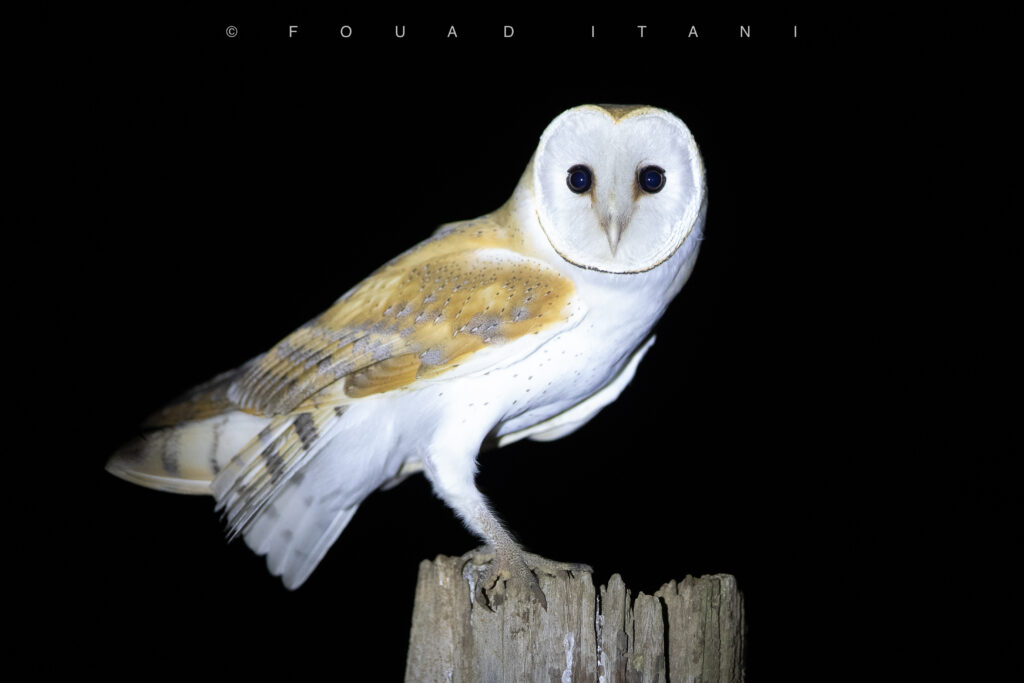
English name: Barn OwlScientific name: Tyto alba
Lifespan: Typically 4–8 years in the wild, and potentially longer under suitable conditionsDistribution: Widespread globally, including Europe, Africa, Asia, the Americas, and the Middle EastStatus in Lebanon: Resident and passage species depending on the regionLegal status: Not a game species; protected as a nocturnal bird of prey (the responsible hunter does not shoot it, but protects it)
Characteristics and Behavior:
The Barn Owl is one of the most distinctive nocturnal raptors, easily recognized by its pale, heart-shaped facial disc. Its plumage combines creamy white and golden-brown tones with fine mottling, providing excellent camouflage in old buildings, barns, and agricultural landscapes.
It is primarily nocturnal and is known for its almost silent flight, enabled by the specialized structure of its wing feathers. This allows it to approach prey without sound. The species possesses exceptional hearing, enabling it to locate rodents with remarkable accuracy even in complete darkness, often relying more on hearing than sight while hunting.
Nesting commonly occurs in abandoned buildings, barns, old churches, tree cavities, or purpose-built nest boxes, demonstrating a high level of adaptability in nesting-site selection compared to other owl species.
Ecological Benefits:
The Barn Owl feeds mainly on small rodents, particularly mice and rats, making it one of the most effective natural allies in agricultural pest control. Scientific studies have shown that a single breeding pair can eliminate thousands of rodents during one breeding season.
This ecological role directly supports crop protection, reduces reliance on poisons and chemical rodenticides, and lowers health risks associated with rodent population growth and disease transmission. For these reasons, Barn Owls are widely used in many countries as a sustainable, biological pest-control solution in farms and agricultural systems.
The species favors open habitats near farmland, grasslands, and plains where prey availability is high.
Scientific References
- BirdLife International – Species Factsheet: Barn Owl (Tyto alba)https://datazone.birdlife.org/species/factsheet/barn-owl-tyto-alba
- IUCN Red List of Threatened Species – Tyto albahttps://www.iucnredlist.org/species/22688504
- Handbook of the Birds of the World Alive – Owls (Lynx Edicions)https://www.hbw.com/species/barn-owl-tyto-alba
- Taylor, I. (1994). Barn Owls: Predator–Prey Relationships and Conservation. Cambridge University Press