Lifespan: 25–30 yearsDistribution: From Southern Europe and North Africa to India; migrates through Lebanon.Status in Lebanon: Migratory passage species.
Characteristics and Behavior:
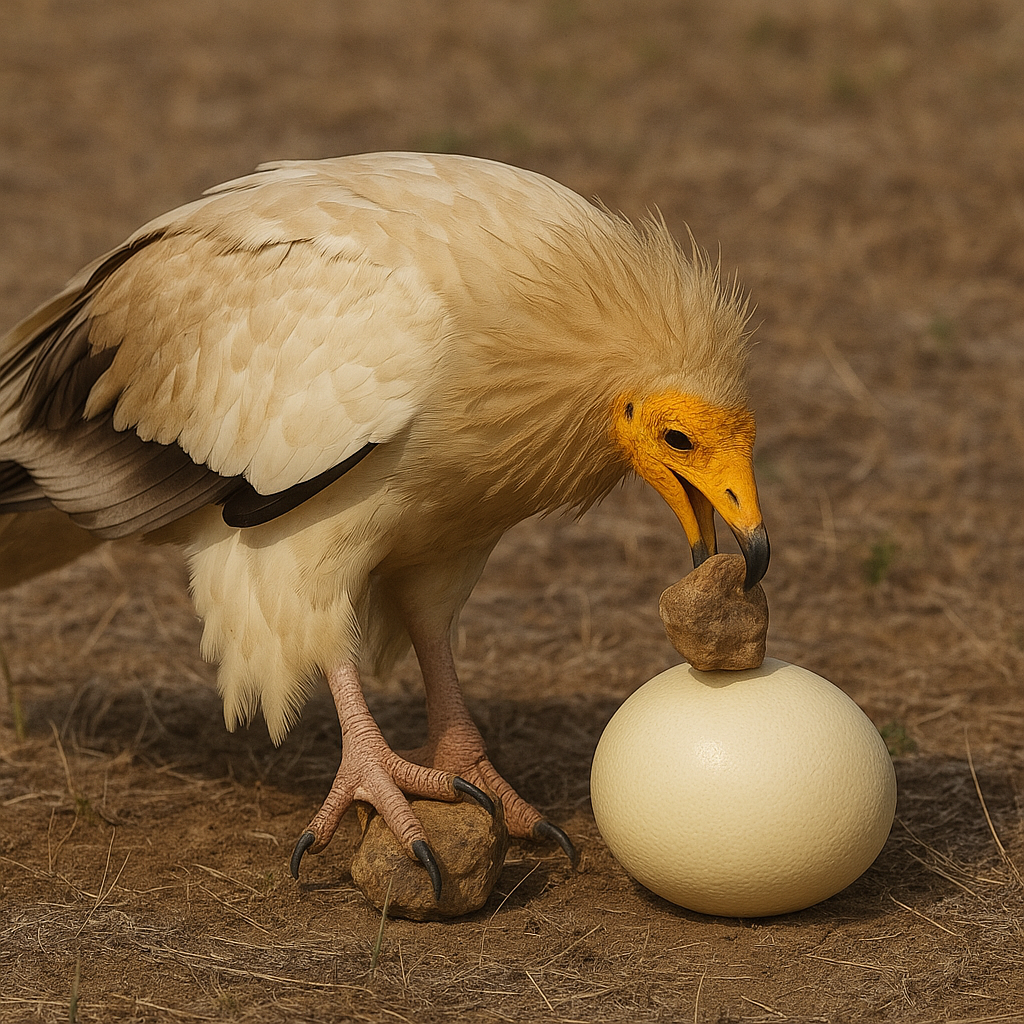
The Egyptian Vulture is considered one of the most intelligent birds of prey and is among the earliest bird species scientifically documented to use tools. It uses stones to break large eggs, such as ostrich eggs.It feeds on carrion, eggs, and organic waste. Its bare, featherless face is a hygienic adaptation that reduces bacterial contamination while feeding.
Ecological Importance:
The Egyptian Vulture plays a crucial role in cleaning the environment of carcasses and organic waste, thereby limiting the proliferation of bacteria and parasites and reducing the risk of disease spread.It also contributes directly to reducing zoonotic diseases (diseases transmitted between animals and humans), as its highly acidic digestive system is capable of destroying most pathogenic microorganisms instead of dispersing them into the environment.
Scientific studies have shown that the decline of vulture populations leads to the accumulation of unremoved carcasses, creating favorable conditions for the increase of stray dogs and rodents. These animals are direct carriers of serious diseases affecting humans, such as rabies, leishmaniasis, and bacterial poisoning.For this reason, the Egyptian Vulture is considered a key component in maintaining ecological balance and protecting public health.
The Egyptian Vulture in History and Cultures:
The Egyptian Vulture has been associated with several ancient civilizations, most notably Ancient Egypt, where it was regarded as a symbol of protection and divine power. It is widely believed to be the inspiration for the goddess Nekhbet, the protector of kings, who was depicted as a vulture spreading her wings above royal crowns.Conversely, in some popular cultures, negative beliefs developed around the species, linking it to death or bad omens due to its scavenging behavior. These perceptions are not based on science but rather on a misunderstanding of its vital ecological role.
Today, the Egyptian Vulture is globally classified as an Endangered species, due to indirect poisoning, illegal hunting, and the loss of suitable habitats, as well as a general lack of awareness of its ecological value.Protecting this species is not merely about conserving a bird; it is about safeguarding an entire ecological system and, ultimately, human health itself. Nature protects us when we protect its essential components.
References (Scientific and Official Sources):
- IUCN Red List of Threatened Species – Egyptian Vulture (Endangered)https://www.iucnredlist.org/species/22695180
- BirdLife International – Species Factsheet: Egyptian Vulturehttps://datazone.birdlife.org/species/factsheet/egyptian-vulture-neophron-percnopterus
- Ogada et al., 2012 – Effects of Vulture Declines on Disease TransmissionBiological Conservationhttps://www.sciencedirect.com/science/article/pii/S0006320712003990
- UNEP – Why Vultures Matterhttps://www.unep.org/news-and-stories/story/why-vultures-matter
- British Museum – Nekhbet and Vulture Symbolism in Ancient Egypthttps://www.britishmuseum.org/collection
- World Health Organization (WHO) – Rabies and Stray Dogshttps://www.who.int/news-room/fact-sheets/detail/rabies