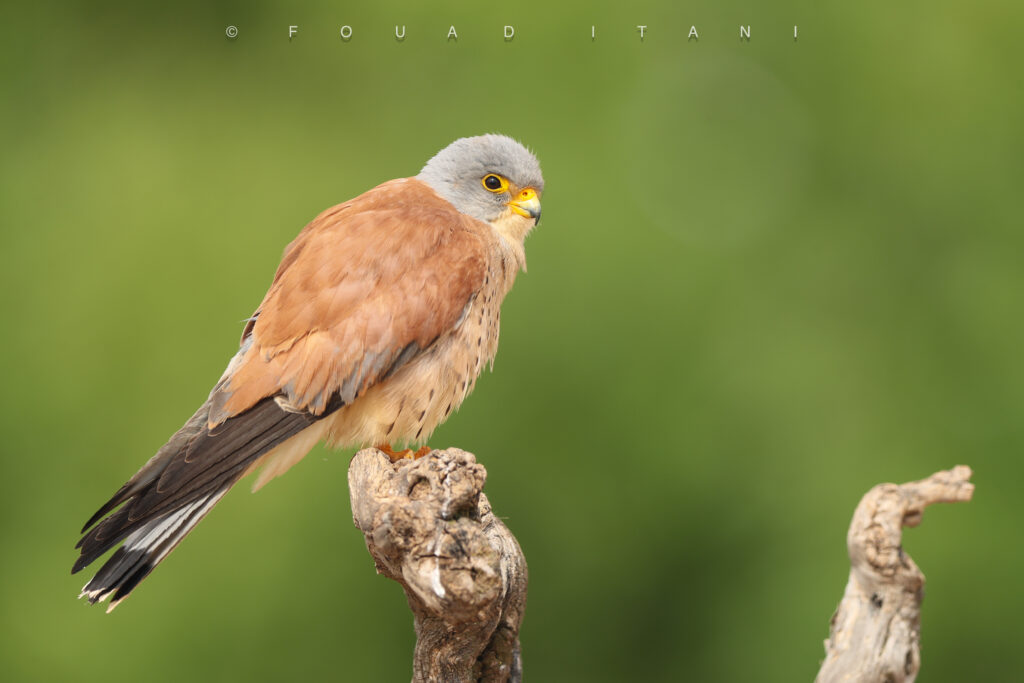
English name: Lesser KestrelScientific name: Falco naumanni
Lifespan: Typically 10–15 yearsDistribution: Southern Europe, North Africa, the Middle East, Central Asia; winters in sub-Saharan AfricaStatus in Lebanon: Migratory passage speciesLegal status: Not a game species; protected as a wild bird (the responsible hunter does not shoot it, but protects it)
Characteristics and Behavior:
The Lesser Kestrel is a small, elegant falcon with long, pointed wings and a graceful flight style. Adult males are distinguished by a bluish-grey head and tail, a rufous back with dark spotting, and pale underparts marked with fine streaking. Females and juveniles are browner and more heavily streaked, providing effective camouflage.
Unlike larger falcons, this species relies more on buoyant, gliding flight and frequently hovers briefly while searching for prey. It is highly social, often nesting in loose colonies rather than as isolated pairs, particularly in old buildings, cliffs, or cavities.
During migration, it travels long distances between breeding grounds in Europe and Asia and wintering areas in Africa, passing through the eastern Mediterranean, including Lebanon, along established migration corridors.
Ecological Benefits:
The Lesser Kestrel feeds mainly on large insects such as grasshoppers, crickets, beetles, and locusts, making it an important natural regulator of agricultural pests. Small vertebrates, including lizards and rodents, may be taken occasionally, especially during the breeding season.
By controlling insect populations, this falcon contributes directly to ecosystem balance and supports sustainable agriculture, reducing the need for chemical pesticides. Its presence is often considered an indicator of healthy open landscapes and traditional farming systems.
It typically forages over grasslands, steppe habitats, agricultural fields, and open countryside, where prey availability is high.
Scientific References
- BirdLife International – Species Factsheet: Lesser Kestrel (Falco naumanni)https://datazone.birdlife.org/species/factsheet/lesser-kestrel-falco-naumanni
- IUCN Red List of Threatened Species – Falco naumannihttps://www.iucnredlist.org/species/22696357
- Handbook of the Birds of the World Alive – Kestrels and Falcons (Lynx Edicions)https://www.hbw.com/species/lesser-kestrel-falco-naumanni
- Birds of the Western Palearctic – Lesser KestrelCramp, S. & Simmons, K.E.L. (1980). Oxford University Press